The Holga Lens Experiment
Anyone who knows my work well knows I love toy cameras, in particular my 35mm, purple, glow-in-the-dark Holga. This camera, along with my Polaroid 660, aided in the creation of a majority of my senior work, including my entire BFA show, and, even though I have not used it since then, it still holds a special place in my heart and a special place on my toy camera display shelf. A couple weeks ago, while looking for a new SD card to replace on of mine that had failed, I saw that the Holga HL-N lens was on sale on B&H’s website for $12. I have been eyeing this lens for a while, and figured that now was the time to finally buy it and give it a test.
First, let’s talk briefly about the lens itself:
It’s plastic.

Yep… plastic
In fact, the only part of the lens that is not plastic are the two microscopically-thin metal sheets inside the lens that produce the vignette you see on Holga images. This lens is basically a glorified air-hockey puck, and it weighs about as much as one, too. It advertises itself as being a 60mm f/8 lens, as is the Holga standard, but I would argue that the depth-of-field on this camera is more in the f/18-25 range (this varies from lens-to-lens, because, well, it’s plastic, and no two lenses are going to be exactly the same — it comes with the territory). I would argue that this helps the lens more than it hurts it, though, because it is near-impossible to get anything in focus with the lens as is — I can’t imagine how blurry everything would be if the aperture was actually f/8. It also has a focal range of “single person” person (so, up-close) to “mountains” (so, far away), but I find that this “range” means little to nothing, as setting a different focal length does not make the image more/less “in-focus,” and is hardly worth taking the time to talk about. I set mine to “single person” and left it there.

Meaningless ranges are meaningless
Another thing about this lens is that, due to the high/slow aperture, you have to keep your ISO speeds pretty high and your shutter speeds pretty low to compensate for the lower amount of light being let in. I did find that, in bright light, I could get away with an ISO of 400 and a shutter speed of 1/80, but, in most cases, I was shooting upwards of ISO 1250 with a shutter speed of 1/60, and in some cases I had to go up to ISO 1600 or down to a shutter speed of 1/50 (which is the lowest shutter speed I can shoot at without needing to bring in a tripod for stabilization).
The last I want to say here is that it is extremely difficult to see what you are doing through the viewfinder. The view through the viewfinder is dark, and, much like with a Holga film camera, you are forced to guess at what you are doing. The element of surprise is not lost with this lens, in spite of the camera being digital instead of film, and I can get on board with this. It makes using it that much more fun, especially for those of us who already have experience with toy cameras.
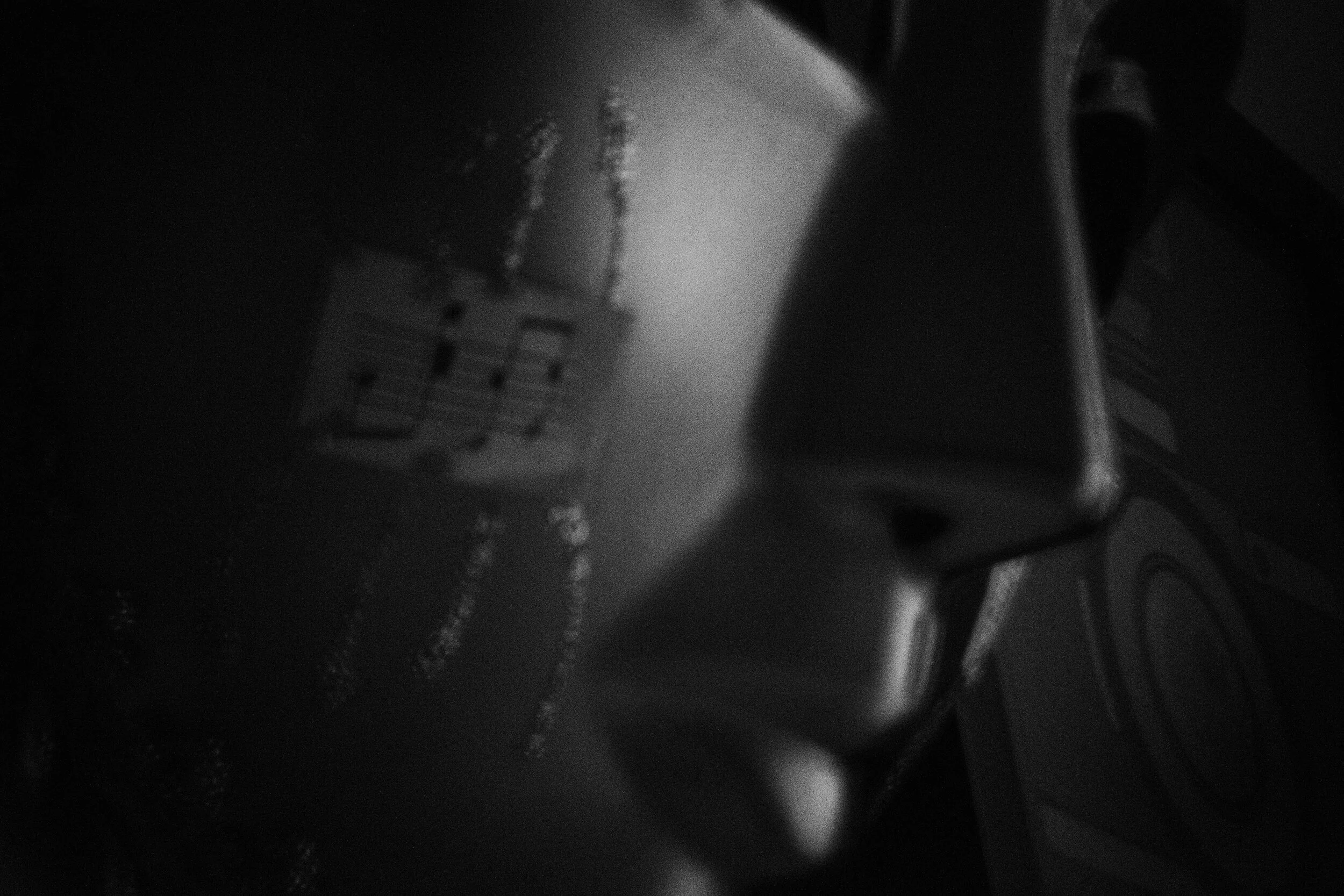
Now that we’ve talked about the lens, here are some of the images I shot:

Behind the Mask

Flight

Winter Winds

Shut-Out

Nineteen-Seventy-Nine
Finally, here are my thoughts on the Holga HL-N (HL-C if you are a Canon user) lens:
The experience of shooting with this lens is not too different from the experience of shooting with an actual Holga camera; it performs poorly in low-light situations, you have to use a high ISO speed and keep the shutter speed around 1/60, and you still have to do a bit of post-development finagling to get your images to turn out the way you want them to. This is not a bad thing. It is, in fact, the reason I love toy cameras in the first place — you never know what you’re going to get until you’ve finished.
What surprised me most when I sat down to edit these photos is just how similar to my old film images they look. Sure, it isn’t exactly the same, but the fact that it is even similar is pretty crazy to me.
Must be something about the plastic, y’know?
…
Anyway, all-in-all, I absolutely adore this quirky little lens. For $12, this lens is worth picking up and playing with. In my case, it has earned a place in my regular lens rotation, for when I want to have that much more fun with my work. If you are interested in purchasing this lens, here is the link to the Nikon-compatible version, and here is the link to the Canon-compatible version.
As always, thank you so much for reading, and, if you have any questions or suggestions for future blog posts, don’t hesitate to reach out by commenting or by emailing me via the “contact” link at the top of the page.
Talk to you again soon!
The Beginning of the End of Entry-Level DSLRs and the Transition to Mirrorless

A few days ago, I opened up Google Chrome on my phone, and I was met with this suggested article: The Death of the Entry-Level DSLR is Upon Us: Nikon Calls Time on the D3500 and D5600.
I was stunned.
There is a huge market out there for entry-level DSLRs, from students buying them for their first photography class to parents buying them to take better pictures of their kids at ball games and other functions than cell phone or point-and-shoot cameras can provide, and, while Nikon is not yet discontinuing the sale of these cameras in the U.S. and other markets outside of Japan, it is clear that, eventually, they will be phased out. It is also clear that, once they are phased out, they will not be replaced.
For the past three years, Nikon has shifted their focus to the mirrorless market, and they are set to continue to do so as they are facing a huge $720M loss this financial year. Mirrorless cameras are seeing a surge in popularity as more companies are adding mirrorless cameras to their lineups, an, from this standpoint, I can see why Nikon would want to focus on them; their Z-series is popular with the market, and they have to do what is profitable (and, to be fair, they say this measure is only “temporary” while they recoup their losses — we shall see).. I have seen theories floating around within the community that Nikon will eventually create an entry-level mirrorless system to add to their lineup, and while I think this is a much-needed addition (the lowest-end mirrorless system Nikon offers starts at $860 US, which is $250 more than the advanced-entry D5600 and $350 more than the entry-level D3500), it still does not, in my mind, replace the need for entry-level DSLRs.*
*Here is a link to an article describing the difference between DSLRs and mirrorless cameras. I did not want to move on before I described the terminology being used, and, well, someone has already done that for me, so there you go.
As I mentioned previously, the market for entry-level DSLRs is that of amateurs — people wanting cameras to take photos of their kids, people picking up photography as a hobby, people wanting to learn photography, and students (this is not an exhaustive list, but you get the idea). Most of these people cannot afford to jump in and spend a small fortune on a camera and a few lenses, and thus will go with an entry-level crop-sensor camera to fulfill their needs (in the world of Nikon, these crop-sensor models are their DX models). Nikon will continue to make their other, more expensive crop-sensor cameras (the popular D7500 starts at $1000 US, while their flagship DX model, the D500, starts at $1500 US), but these are not “budget” models, and this means people will have to look to other camera companies, such as Canon, to get what they want.
As a student, I went with Nikon because a) I had a Nikon point-and-shoot camera I loved (still have it, still love it 8 years later) and b) when I was doing my research, I found that Nikon put better glass in their lenses than Canon, plus I liked Nikon’s color-grading straight out of the camera more than I liked Canon’s (Nikon leans more green, Canon leans more blue — I will make a separate guide to choosing a digital camera later on, which will cover this in detail). I also loved that Nikon’s lenses were backward-compatible, which meant I could put a lens from the 1950’s on my mid-2010’s camera and it would still work, albeit without modern features such as autofocus and vibration reduction; this is huge, as you cannot do this with a Canon, since they changed their lens mount when switching from film to digital, and, since I also shoot film on a Nikon F5, it means a lot to me that I can use any of my lenses on either of my cameras and they will work without the need for a mount adapter. I am so passionate about this that, if someone asks me what I recommend as far as digital cameras are concerned, I always tell them to go with a Nikon from the D3000 or D5000 lines, and I lay out for them all of the reasons I just laid out for you, especially if I know they are taking a photography class that also has a film component and they are planning on picking up their own film camera as well. However, this will be more difficult, if not impossible to do once Nikon ends the sale of these entry-level cameras, because none of the people who have asked me this question thus far have $1000, or even $860, to drop on a camera.
Another reason this is particularly disadvantageous to students is because most photography classes teach the art of photography using traditional DSLRs, as mirrorless systems are too new to be mainstream enough to be taught on. Until there are better, less expensive mirrorless options out there, I don’t see the transition to mirrorless happening in the classroom any time soon.
This is not me saying that mirrorless cameras are bad; in fact, I fully intend on upgrading to a full-frame mirrorless system sometime in the future, as I believe these cameras are perfect for the kind of photography I am into. However, if Nikon is successful in this venture, this could lead the way for other companies, like Canon, to do away with their entry-level cameras, in much the same way Apple has taught other cell phone companies that they can do away with features, such as headphone jacks, on their phones, or computer companies that they can do away with ports on their laptops and force everyone to use dongles for every basic need (bitter, much? You know it’s all true). The other issue I see here is that, often times, the brand a photographer learns on is the brand the photographer sticks with, and the discontinuation of these entry-level DSLRs will lead to those who would have bought these cameras to another brand that does have entry-level models, thus shutting out an entire group of people who, over time, would have continued to grow their Nikon collection, which, in turn, would have created future profit for the company. Just a little food for thought.
For now, we will have to wait and see. It will likely be another couple of years before Nikon pulls the D3500 and D5600 off of the market completely, and hopefully by that time we will see an entry-level mirrorless system or two taking their place.
I know this is not one of my better or more exciting posts, but I wanted to put my opinion on the matter out there, as getting people into photography is a huge passion of mine, and limiting people’s options for getting into photography is not. I promise I will be back on a fun topic next week, but, for now, let me know how you feel about this weird transitional period Nikon is in.
See you next Friday!